



 Jordan Bevan
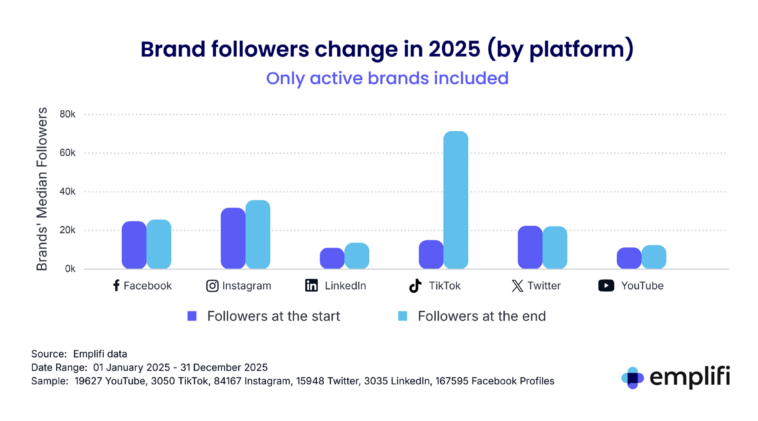
Social media performance is no longer rising or falling in tandem across platforms. New benchmark data indicates that 2026 has opened with widening gaps in engagement, audience growth, and content effectiveness, forcing brands to rethink cross-platform parity strategies.
According to Emplifi’s latest Social Media Benchmark Report, performance divergence accelerated through 2025, with TikTok consolidating its position as the primary engine of interaction while other major networks settled into more specialized roles .
TikTok continues to outpace competitors by a substantial margin. Median brand follower growth surpassed 200% year over year, while engagement rates peaked near 35.9% before closing 2025 at 27.6%—still significantly higher than rival platforms .
Large brand accounts on TikTok generated more than twice the interactions seen on Instagram and more than 20 times those on Facebook. The report attributes this to TikTok’s discovery-driven algorithm, which distributes content beyond follower bases and reduces reliance on existing audience size .
By late 2025, more than 70% of TikTok video views came from the For You feed, while traffic from profile pages and search declined. The shift further weakens the traditional advantage of large follower counts .
Instagram remains central to most brand media plans, but its engagement trajectory has softened. Median engagement fell from 16.9% in early 2024 to 9.7% by the end of 2025, reflecting growing competition for attention and changing user behavior .
Content format performance also diverged. Carousels and Reels generated approximately 44% more interactions than static images, signaling that passive consumption formats are losing ground to dynamic storytelling .
Facebook’s role has become more predictable. Median engagement rates fluctuated between 1.4% and 2.4% throughout 2025, reinforcing its position as a reach and conversion channel rather than an engagement driver .
Live video significantly outperformed other formats on the platform, delivering roughly four times the engagement of link posts and six times that of image posts . For advertisers, this suggests that format optimization matters more than scale alone.
Audience growth on X remained flat to negative across much of 2025, narrowing its strategic value to real-time conversation and event-driven engagement . Even so, lightweight formats such as animated GIFs outperformed text-only posts, indicating that visual stimulation remains critical even in fast-moving feeds .
The broader implication is structural. Social platforms are no longer functioning as interchangeable distribution channels. Each network now operates with distinct economics, algorithmic mechanics, and engagement ceilings.
TikTok increasingly functions as a growth engine fueled by algorithmic discovery. Instagram rewards shareable, dynamic content. Facebook delivers stable reach and retargeting efficiency. X retains relevance for immediacy rather than scale.
For marketers, the shift demands sharper allocation decisions. A diversified presence is no longer sufficient; platform strategy must reflect each network’s behavioral dynamics. The era of uniform social playbooks appears to be over.



Comments
Loading…