



 Sophie Blake
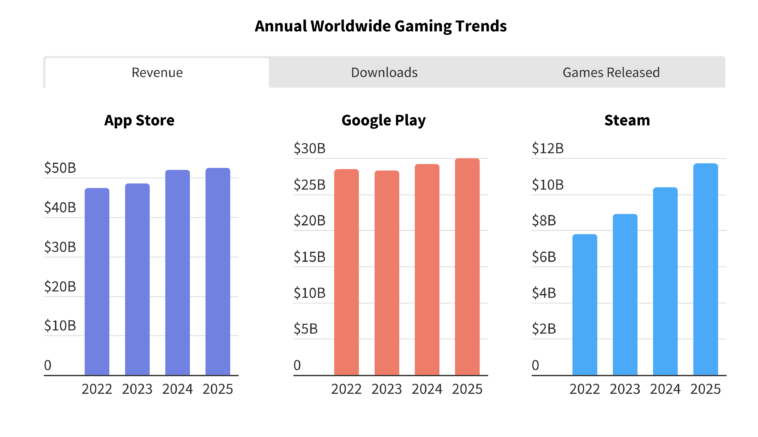
Global mobile gaming revenue edged up just 1% year over year to $82 billion in 2025, signaling a period of stabilization for the sector even as total downloads continued to fall, according to Sensor Tower’s State of Gaming 2026 report.
Across mobile, PC, and console platforms, players downloaded 52 billion games in 2025. Mobile titles accounted for the overwhelming majority of that activity, averaging approximately 95,000 downloads per minute throughout the year. However, overall mobile downloads declined compared to 2024, underscoring what analysts describe as a maturing market where user acquisition has become more difficult and growth increasingly depends on extracting more value from existing audiences.
App Store Outpaces Rivals in Revenue
On iOS, the App Store generated a record $52.5 billion in gaming revenue in 2025, up 0.6% from the previous year. That total exceeded the combined game revenue of Google Play, which reached $30 billion, and Steam, which reported $11.7 billion.
Despite leading in revenue, Apple’s platform saw 7.8 billion game downloads, a 5.7% year-over-year decline. Google Play, which continues to dominate in volume, recorded 42.4 billion downloads, down 7.3%. By contrast, Steam downloads rose 6% to 857 million, reflecting stronger momentum in the PC segment.
Release volume also diverged sharply between platforms. The App Store hosted 55,300 new game releases in 2025, an 11.4% increase year over year. Google Play added 150,000 new titles, up 45.9%, while Steam saw roughly 20,000 releases, up 8.4%.
Engagement Remains High as Monetization Strategy Shifts
Although download growth has slowed, player engagement remains substantial. Consumers spent a combined 444.6 billion hours playing mobile games worldwide in 2025. Sensor Tower’s analysis indicates that developers are increasingly prioritizing retention and monetization strategies over aggressive user acquisition.
Tactics such as live operations, in-game events, intellectual property collaborations, and web-based storefronts are being used to maintain revenue stability in a saturated marketplace. With fewer new installs, publishers are placing greater emphasis on lifetime value per user.
Advertising allocation patterns also shifted during the year. YouTube’s share of mobile game ad spend increased, while its share among PC and console campaigns declined, indicating a rebalancing of marketing budgets toward mobile audiences.
Strategy Titles Lead Genre Growth
Among mobile genres, 4X strategy games were the only category to record simultaneous gains in revenue, downloads, and time spent. Titles such as Last War: Survival and Whiteout Survival ranked as the top two mobile games by revenue in 2025, reflecting sustained demand for long-session, progression-based gameplay.
The broader genre landscape suggests a move toward deeper engagement models rather than hypercasual formats that previously drove high install volumes.
Roblox Dominates User Base
User concentration at the top of the market remained pronounced. Roblox averaged nearly 450 million monthly active users in 2025, including close to 100 million users on iOS alone. The platform ranked as the leading app among both male and female users in the United States across the 18–54 age range.
Audience segmentation data shows notable demographic patterns across mobile gaming. Hypercasual titles skew more heavily toward female players, while PC gaming audiences trend younger overall. For users aged 55 and older, puzzle and word-based titles, including NYT Games, led engagement rankings.
A Mature Market Facing Slower Expansion
The data points to a mobile gaming ecosystem that remains financially dominant but is no longer expanding at the pace seen in earlier growth cycles. Revenue stability in the face of declining downloads indicates that monetization efficiency has improved, yet it also highlights structural saturation in user acquisition.
With App Store revenue alone exceeding the combined gaming income of Google Play and Steam, mobile continues to represent the largest share of global interactive entertainment spending. However, 2025’s performance suggests that future gains will depend less on scale and more on sustained player retention and diversified revenue channels.



Comments
Loading…