



 Maya Robertson
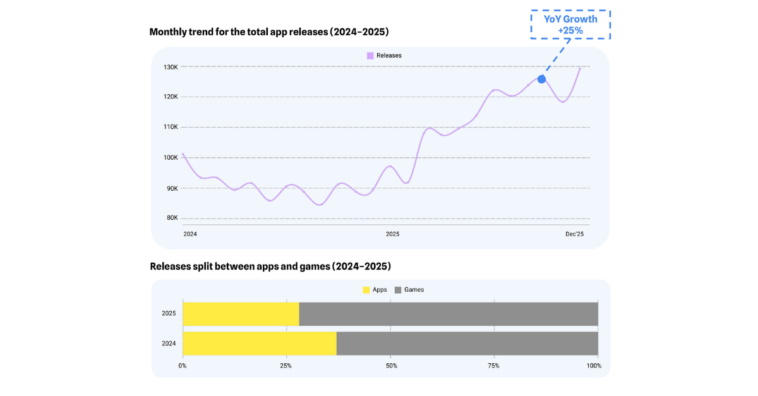
The global app economy expanded sharply in 2025, with releases climbing 25% year over year to exceed 1.4 million new apps. Yet the surge in supply did not translate into broad visibility: only around one in ten new launches managed to capture meaningful user attention, underscoring intensifying competition across app stores.
That imbalance between production and discovery is one of the central findings in the Mobile Market Landscape 2026 report by AppMagic, which examines structural shifts reshaping both gaming and non-gaming segments. While the barriers to publishing continue to fall, the data suggests that distribution and user acquisition have become decisive constraints.
Non-Gaming Apps Outpace Games in Revenue
Despite saturation pressures, the overall market continued to grow. Compared to 2024, non-gaming app downloads rose 11.9%, while revenue increased 19.1%, with gains distributed across multiple categories rather than concentrated in a handful of leaders.
A milestone came in September 2025, when non-gaming apps overtook games in monthly revenue, generating $4.8 billion compared to $4.5 billion for games. The revenue gap has continued to widen, signaling a longer-term rebalancing of the mobile economy after years of gaming dominance.
The shift reflects expanding monetization in categories such as entertainment, social platforms, tools, and increasingly, generative AI.
Generative AI Emerges as the Breakout Segment
Among all verticals, generative AI posted the most pronounced growth. In 2025, GenAI apps recorded a 178% increase in downloads and a 273% surge in revenue, marking one of the most significant structural inflection points in recent mobile history.
The expansion signals that AI-driven functionality is moving beyond experimentation into mainstream consumer behavior. Rather than serving as isolated novelty apps, GenAI tools are embedding themselves across productivity, creativity, and everyday utilities.
Visibility Crisis in a Crowded Market
However, the headline growth masks an increasingly concentrated attention economy. With more than 1.4 million new apps released last year, competition for store rankings, paid acquisition inventory, and organic discovery intensified sharply.
Only approximately 10% of launches achieved meaningful traction, reinforcing a power-law dynamic in which a small subset of titles captures the majority of downloads and revenue. For developers, this implies higher marketing costs, stronger reliance on paid channels, and increased importance of creative optimization and retention mechanics.
AI Reshapes Game Marketing and Monetization
Gaming remains a core pillar of the mobile ecosystem, but its growth patterns are evolving. Artificial intelligence has become embedded not only in gameplay mechanics but also in user acquisition strategies. In 2025, 56 of the top 100 grossing mobile games deployed AI-generated ad creatives, reflecting the normalization of automated creative production.
At the same time, monetization strategies are shifting. While direct in-app purchase growth moderated, revenue from direct-to-consumer (D2C) and alternative payment systems rose 26% year over year across games in the Americas. Among the top 100 titles, D2C earnings increased 38%, indicating a deliberate effort to reduce platform fee exposure and diversify revenue channels.



Comments
Loading…