



 Maya Robertson
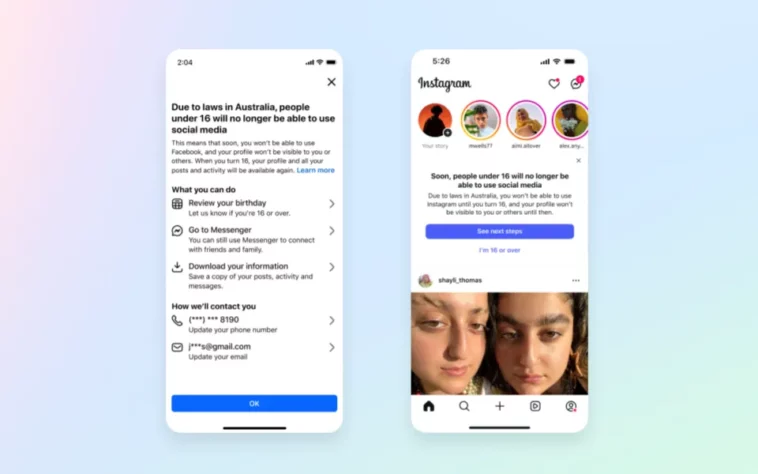
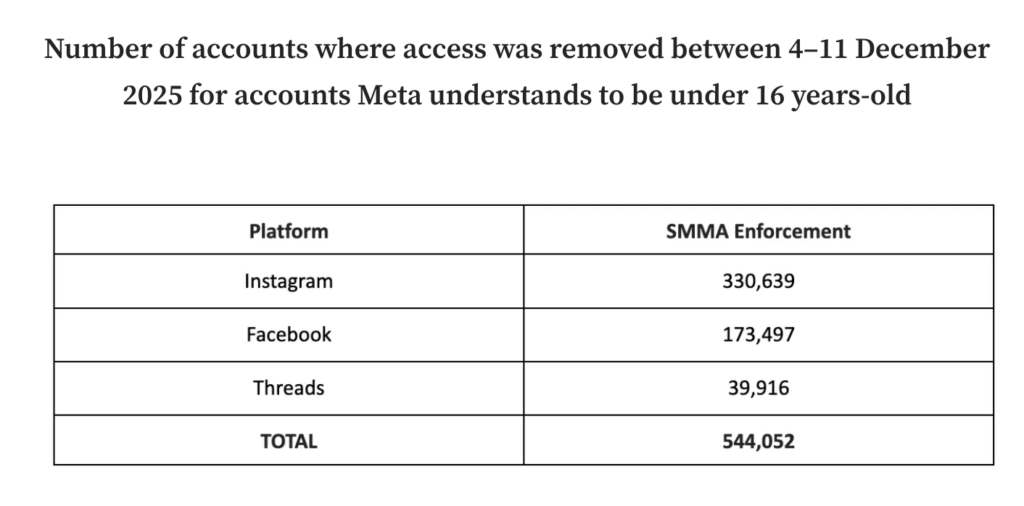
Meta says it has removed access to close to 550,000 accounts in Australia that it believes belonged to users under the age of 16, as the country’s new social media age ban enters its first month of enforcement. The law, which came into force on December 10, places responsibility on platforms to prevent under-16s from holding social media accounts or face penalties of up to A$50 million.
According to Meta, the account removals were carried out between early and mid-December across Facebook, Instagram, and Threads as part of its initial compliance measures. The company described enforcement as an ongoing, multi-layered process that it expects to refine over time, while highlighting the absence of a mandated, industry-wide standard for verifying users’ ages online.
Instagram is likely to be the most affected platform, given its popularity among younger users. The scale of removals exceeds earlier disclosures from rivals such as Snapchat, which reported around 440,000 Australian users under 16 prior to the law’s introduction. Despite the reported enforcement activity, questions remain about the law’s practical impact, as teens can still access content through logged-out use, VPNs, or alternative platforms.
To strengthen its approach to age assurance, Meta has joined the OpenAge Initiative, a non-profit focused on interoperable age verification. Through this effort, Meta plans to integrate “AgeKeys” into its apps in Australia and other markets in 2026. The system allows users to verify their age using methods such as government-issued ID, financial data, facial estimation, or national digital wallets, and then share a verified age signal with participating platforms in a privacy-preserving way.
Meta argues that while tools like AgeKeys may improve age checks, they still require users and parents to verify age on an app-by-app basis. The company has reiterated its position that more consistent enforcement would be achieved through age verification and parental approval at the app store level, where downloads can be controlled before access is granted.
The company has also raised concerns about unintended consequences of the ban. These include the risk of pushing teens toward less regulated apps or online spaces, limiting access to supportive online communities, and creating uneven safety standards across platforms. Meta also disputes the law’s premise that banning accounts prevents exposure to algorithmic content, noting that logged-out experiences can still involve algorithmic recommendations, albeit with reduced personalization.
Meta says it remains committed to complying with the legislation while calling on Australian authorities to engage more closely with industry on alternative frameworks. As other countries consider similar age-based restrictions, the early Australian experience is likely to be closely watched by regulators, platforms, and advertisers alike.



Comments
Loading…