



 Maya Robertson
The Epic Games Store closed 2025 with record third-party game revenue and its highest-ever monthly active user count, while overall engagement on the platform declined, highlighting a mixed performance year for Steam’s largest PC storefront rival.
According to Epic Games’ annual review, player spending on third-party PC titles rose 57% year over year to $400 million, helping push total store spending to $1.16 billion, up 6%. Epic reported 78 million monthly active users in December 2025, driven in part by seasonal promotions and high-profile free game giveaways, including Hogwarts Legacy. The store’s catalog also expanded past 6,000 games during the year.
Third-Party Growth Offsets First-Party Decline
While revenue and December activity reached new highs, total gameplay hours across the Epic Games Store fell 14% year over year to 6.65 billion hours. Epic attributed the decline primarily to reduced engagement in first-party titles, led by Fortnite. Time spent in third-party games, by contrast, increased 4% to 2.78 billion hours, indicating a gradual shift in how players use the platform.
Epic Games Store general manager Steve Allison said the data reflects Fortnite coming off an unusually strong prior year, noting that the title remains the most-played game on the platform despite the drop. Analysts have previously suggested that mature live-service games may face structural limits to long-term engagement growth.
The most-played PC titles on Epic in 2025 included Fortnite, Wuthering Waves, Honkai Star Rail, Rocket League, and Genshin Impact, followed by games such as EA SPORTS FC 26, Grand Theft Auto V, and Dead by Daylight. Epic did not disclose title-level revenue figures.
Free Games Program Continues to Drive Discovery
Epic’s long-running Free Games Program remained a major acquisition and discovery tool. Players claimed 662 million free titles in 2025, with Epic reporting that more than 77% of those games reached an all-time peak in concurrent users during their free promotion window. Epic also cited a 40% increase in Steam concurrent players for titles while they were being offered for free on Epic, suggesting spillover effects across the wider PC ecosystem.
Despite the scale of giveaways, average engagement metrics softened over the year. Average monthly active users fell 1% to 67 million, while daily active users declined 2% to 31 million, indicating that headline growth was concentrated in peak seasonal periods.
Developer Incentives and Platform Expansion
Epic continued to emphasize developer-friendly economics as part of its growth strategy. In 2025, the company introduced a revised revenue model allowing developers to keep 100% of their first $1 million in annual net revenue per product before shifting to the standard 88/12 split. Programs such as Epic First Run, which offers six months of exclusivity with full revenue retention, reached record participation levels, though Epic did not share exact figures.
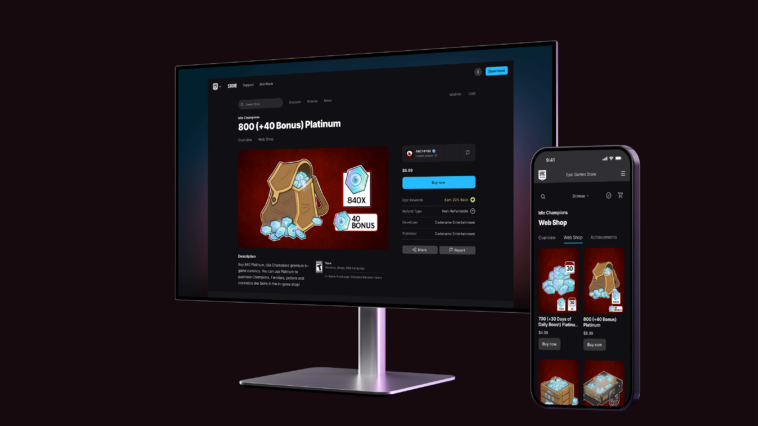
The company also launched Epic Web Shops, enabling developers to sell digital content directly to players using Epic’s ecommerce infrastructure across PC and mobile. Developers can process in-game purchases using their own payment systems without paying Epic a commission.
Storefront Overhaul Planned for 2026
Looking ahead, Epic confirmed plans to overhaul the Epic Games Store launcher in mid-2026, rebuilding its underlying architecture to improve performance, responsiveness, and stability. The update follows longstanding user complaints about resource usage and load times compared with Steam.
Epic is also expanding social features, including cross-platform text chat, upcoming voice chat, avatars, and community spaces, alongside deeper integration with Fortnite and Epic Online Services. Additional initiatives include marketing programs that link Epic Games Store purchases with Fortnite cosmetics, as well as further mobile expansion in markets such as Japan and Brazil.
Positioning Against Steam
Despite the year’s gains, Epic Games Store remains well behind Steam in overall revenue share. Industry surveys indicate that for most developers, Steam still accounts for more than 75% of PC revenue. Epic has repeatedly said it is not aiming to displace Steam outright, instead focusing on increasing its share of sales for games released on both platforms.
The 2025 results underline that strategy: strong third-party sales growth and developer participation alongside softer engagement trends tied to Epic’s own flagship titles. Whether upcoming platform improvements and incentives can translate into sustained user growth remains a key question for 2026.



Comments
Loading…