



 Sophie Blake
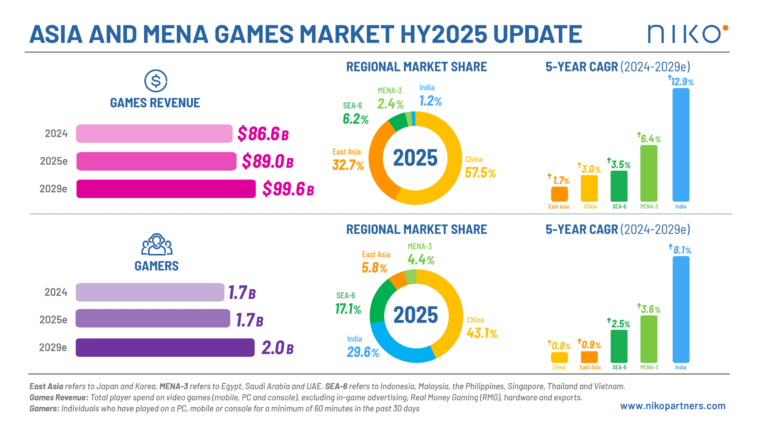
The Asia and MENA games industry is expected to generate $88.97 billion in revenue in 2025, according to new projections from Niko Partners, reflecting a 2.7% year-over-year increase and a stronger performance than anticipated earlier in the year. The combined gaming population across both regions is also set to rise 2.7% to 1.70 billion players.
The updated forecast, drawn from Niko’s November 2025 market model and half-year analysis, attributes the improved outlook to stronger mobile and PC performance, regulatory easing in select markets, and a pickup in console spending driven by new hardware cycles.
China, Japan, and South Korea remain the largest and most established gaming economies in the region, and Niko projects they will collectively generate $88.8 billion in player spending by 2029—or more than 89% of regional revenue across the 13 tracked markets.
Higher-than-expected revenues in South Korea, robust adoption of Nintendo’s Switch 2 in Japan, and improved performance across both new and legacy titles in China led analysts to revise long-term forecasts upward.
While the biggest markets continue to deliver the bulk of revenue, the fastest acceleration is taking place elsewhere.
Niko identifies India, the MENA region, and Southeast Asia as the strongest growth markets from 2024–2029, driven by rising payer conversion, expanding demographics, and regulatory shifts that favor domestic games industries. India is expected to surpass $1.5 billion in player spending by 2028 and increase from 500 million gamers in 2025 to 700 million by 2029.
India’s recent PROG Act, which restricts real-money gaming and opens avenues for broader industry support, is viewed as a catalyst for higher engagement and payment rates.
In Southeast Asia, markets such as Malaysia and Vietnam are projected to post the fastest revenue expansion, while Indonesia and Thailand face more muted growth due to economic headwinds and regulatory uncertainty.
Console revenue—just 6.3% of the 2025 market—is projected to be the region’s fastest-growing segment over the next four years. The rollout of Nintendo’s Switch 2, rising spend on multi-game subscription services, and anticipated blockbuster releases such as Grand Theft Auto VI are expected to boost console engagement across Asia and MENA.
Demand for higher-budget, cross-platform titles is also expanding, contributing to greater interest in premium console experiences and the next generation of hardware from major platform holders.
Niko notes stronger-than-expected momentum across mobile and PC, driven by evergreen franchises, new cross-platform AAA titles, and a growing number of paying gamers. Shifts in platform regulation—including increased opportunities for out-of-app monetization—have reduced earlier constraints on growth in several markets.
The firm also highlights increasing engagement among female players and underserved genre-focused communities, which is broadening the total addressable audience.
If current trends hold, the Asia and MENA video games market is on course to exceed $100 billion in annual revenue by 2029, supported by structural demographic growth, favorable policy changes, rising ARPU in emerging markets, and the sustained strength of the region’s largest economies.



Comments
Loading…