



 Sophie Blake
Google has outlined how Meta improved video playback performance on Instagram and Facebook by integrating Jetpack Media3 PreloadManager, an Android media component designed to prepare video content before users tap or swipe to play it.
In a developer case study, Google described how the system was implemented to address delays in short-form video feeds, where users rapidly scroll between clips. Platforms such as Instagram Reels and Facebook News Feed rely heavily on quick transitions between videos, making playback latency a critical technical issue.
Short-form video feeds require media to load almost immediately as users scroll. Traditional approaches, such as disk caching and reactive loading, can introduce delays when a new video enters the screen.
Meta previously relied on a combination of player warmup and video prefetching to prepare content. Warmup involved initializing multiple video player instances in advance, while prefetching downloaded content to the device’s storage. Although these methods improved network efficiency, they also increased memory consumption and limited how many videos could be prepared simultaneously.
Google’s Media3 PreloadManager was introduced to allow developers to preload media directly into memory and coordinate video preparation more efficiently.
To implement the new system, Meta’s Media Foundation Client team integrated the DefaultPreloadManager from Android’s Media3 library into both Facebook and Instagram.
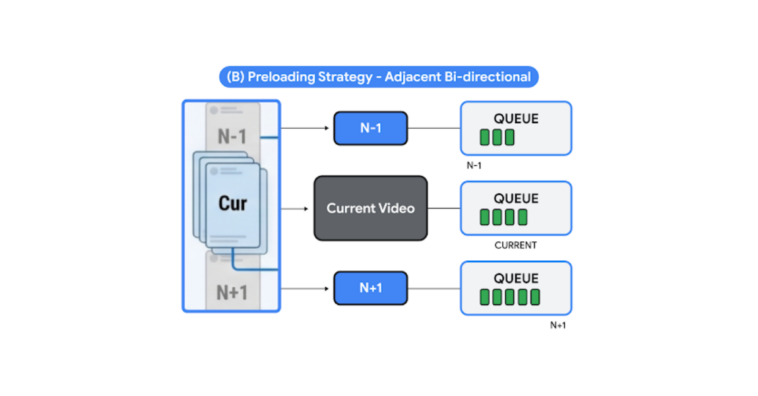
The integration required changes to the existing media architecture so that ExoPlayer instances and the PreloadManager could share resources. Instead of launching multiple video players, the updated setup enables a single player instance to manage multiple preloading tasks in parallel.
According to Google, this approach increased the number of videos that could be prepared ahead of time while reducing the memory overhead associated with the previous warmup method.
Meta adjusted the preloading logic based on how users interact with each app’s interface.
In Facebook’s News Feed, where videos appear between text and image posts, the system prioritizes only the video currently entering view. This “current-only” strategy reduces memory usage in a feed that often contains mixed content.
On Instagram Reels, which consists entirely of vertically scrolling video, the system preloads adjacent clips so they are ready when users swipe. Videos positioned before and after the current Reel are prepared in memory to enable faster transitions.
Google noted that performance tuning was necessary to ensure the system worked across a wide range of Android devices. Early versions of the implementation sometimes increased memory usage or affected scrolling performance, particularly on mid-range and lower-end hardware.
To address this, Meta added device-aware monitoring tools that track CPU activity, memory usage and storage input/output. When the system detects heavy load on a device, the preloading process is temporarily paused to maintain interface responsiveness.
The new architecture reduced the delay between a user action and the first video frame appearing on screen, a metric often referred to as time to first frame.
Google reported that the changes led to faster video starts and fewer playback interruptions, such as buffering or delayed loading. Facebook also recorded fewer problematic playback sessions, while Instagram saw increases in overall watch time after reducing join latency in Reels.
Beyond performance improvements, the adoption of Media3 PreloadManager also simplified parts of the media infrastructure. Google noted that using Media3 APIs allows better resource sharing across playback components and makes the codebase easier to maintain as the platforms scale.

Comments
Loading…