



 Maya Robertson
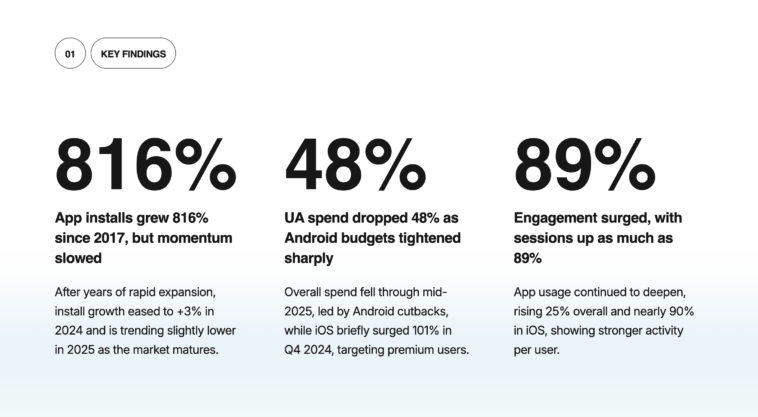
India’s once-surging app market is moving into a more measured phase. After expanding more than eightfold since 2017, overall install growth has begun to flatten. According to a new report from Appsflyer and Google, installs rose just 3% in 2024 and are expected to contract slightly in 2025, signaling a shift away from the breakneck expansion that defined previous years. The slowdown marks a broader transition: marketers are increasingly prioritizing monetizable users, durable engagement, and improved return on acquisition spend.
Smartphone trends reflect this recalibration. Shipments in Q2 2025 reached 39 million units—up 7% year over year—with demand for mid-range and premium models rising. Financing programs and a surge in affordable 5G devices helped accelerate the transition to higher-value hardware. Combined with widespread UPI usage among younger consumers, India is emerging not only as a high-volume market, but as one with increasingly stronger revenue potential.
User acquisition budgets, which peaked in late 2023, have contracted sharply. Per the report, by mid-2025, India’s UA spend had dropped 48%, led by deep cuts on Android. Android budgets fell nearly 50% from late 2023 levels as marketers trimmed always-on campaigns. iOS spending, meanwhile, remained comparatively steadier and even doubled during Q4 2024 as advertisers targeted premium urban users.
These spending patterns produced equally divergent outcomes. Paid installs on Android grew only modestly, while iOS saw a surge of more than 200% across the same period. Remarketing performance showed an even stronger split, with iOS conversions rising more than threefold. Despite the downturn, India remains one of the largest app acquisition markets in the world, with $4.5 billion spent in 2024—most of it to acquire domestic users.
While installs plateaued, app usage continued to grow. Sessions on Android increased 25% between 2023 and 2025, while iOS usage climbed nearly 90%. Payments, commerce, and mobility apps remained the pillars of everyday engagement, with iOS emerging as the platform where users interact more frequently and with higher intent.
The Finance category—once the fastest-growing segment in India—shows mixed signals heading into 2025. The category’s share of total installs has slipped after reaching a high of 25% in 2024. Android paid installs in Finance dropped 40%, while iOS recorded a dramatic 397% increase.
However, the surge in paid installs did not translate into stronger monetization. Remarketing conversions declined on both platforms, suggesting a widening gap between acquisition and transactional activity. For marketers, the sector is no longer driven by raw scale but by the ability to convert and retain paying users.
India’s gaming market, long a driver of app installs, is showing clearer signs of maturity. Paid installs fell 5% in 2025, the report says. Subgenres moved in different directions: hypercasual titles continued to grow via ad revenue, midcore games deepened hybrid monetization, and casino apps leaned further into combined IAA/IAP approaches. Casual games experienced a steep decline as yields weakened.
Monetization now spans three distinct models—ads, in-app purchases, and hybrid—with no single structure dominating. Developers are increasingly tailoring strategies by subgenre rather than relying on broad market momentum.
Shopping remained one of the strongest-performing verticals. India ranked among the top global markets for Shopping app installs in 2025, supported by festival spending and major sale cycles. Paid installs increased 63% on Android and nearly tripled on iOS, while remarketing conversions climbed sharply on both platforms. Sessions grew 26% overall, reflecting consistent demand from consumers across both mass-market and premium segments.
Short-form drama platforms posted one of the year’s most dramatic growth curves, scaling nearly 18 times since early 2024. A striking 94% of installs were driven by paid campaigns, illustrating aggressive early-stage acquisition tactics. But challenges are emerging: 30-day retention rates have fallen more than 50% year over year. Fraud has also risen, prompting platforms to adopt stricter measurement and anti-fraud tools as they seek sustainable growth.
According to the report, fraudulent activity remained a persistent issue, averaging 12% of installs between 2023 and 2025. Finance apps remained the most exposed, with fraud peaking at 38% before easing slightly. Android saw a gradual decline in fraud rates thanks to improved detection, while iOS experienced increased exposure. Install hijacking and sophisticated bot activity continue to pressure acquisition efficiency, particularly in high-value categories.
India’s app ecosystem is no longer characterized by rapid expansion alone. Instead, the market is moving toward a model where Android provides unmatched reach and iOS delivers concentrated efficiency. As volume growth cools, the focus for 2025 and beyond is shifting toward making each acquired user more valuable—through stronger engagement, retention, and fraud prevention.
The next phase of India’s app economy will be shaped less by how quickly it grows, and more by how effectively it converts its massive user base into sustainable long-term value.


Comments
Loading…