



 Maya Robertson
Creative optimization strategies in mobile advertising continued to diverge between gaming and non-gaming apps in 2025, according to AppsFlyer’s recent analysis of 1.1 million video creative variations, $2.4 billion in ad spend, and data from 1,300 apps. The findings show growing creative volume, shifting spend concentration, and clear performance gaps tied to motivation, hooks, and media channels.
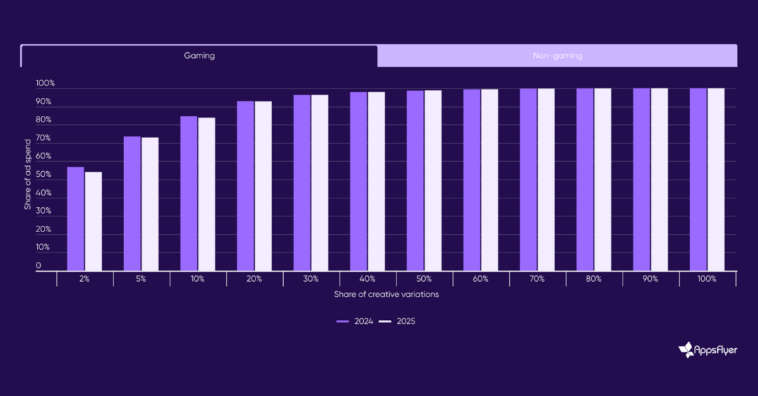
In 2025, the top 2% of gaming creatives accounted for 53% of total ad spend, down from 56% a year earlier, AppsFlyer finds. Non-gaming apps showed an even more distributed approach, with the top 2% capturing 43% of spend, compared to 47% previously. The 10-point gap between gaming and non-gaming highlights distinct strategies: gaming advertisers continue to scale proven winners aggressively, while non-gaming advertisers spread budgets across a wider creative mix to mitigate fatigue and reach broader audiences.
Creative output continued to grow, but unevenly across categories. Non-gaming apps increased creative production by 18% year over year, outpacing gaming by a wide margin. Non-gaming advertisers spending $7 million or more per quarter averaged 2,365 creative variations per quarter, growing 80% faster than gaming at comparable spend levels.
Gaming apps at the same spend tier still led in absolute volume, averaging 2,743 creatives per quarter, but growth slowed significantly. High-spend gaming apps ($1M+ per quarter) increased creative output by just 8% YoY, while lower-spending gaming apps saw a 3% decline, suggesting operational limits and a shift toward optimization over expansion.
Across verticals, retention data consistently pointed to underfunded but high-performing creative themes. In dating apps, creatives focused on “Finding a Serious Relationship” delivered 15% higher Day 7 retention than casual dating messaging, despite receiving less budget and lower creative coverage.
In finance apps, Instant Gratification hooks received roughly 2x more spend on DSPs than on Social & Search, yet DSP traffic delivered 17% higher Day 7 retention, indicating stronger long-term value despite similar acquisition messaging.
Channel-specific performance differences were pronounced in gaming. For casual games, “Pure Success” endings generated 33% higher IPM on ad networks, while on Social & Search platforms, “Pure Failure” narratives outperformed by 65% IPM, reversing conventional assumptions and underscoring the need for platform-specific creative strategies.
In hypercasual games, Challenge-driven creatives delivered 2.2x to 2.5x higher Day 7 retention than Excitement-based creatives across channels, even though Excitement continued to dominate spend due to higher install efficiency.
Celebrity-led creatives showed some of the largest mismatches between spend and results. In mid-core gaming, TV personalities delivered 2x the IPM of movie stars, while music artists led retention, yet over 90% of celebrity budgets were allocated to movie stars. Similar patterns appeared in non-gaming apps, where social media influencers and TV figures outperformed pop stars on retention but received significantly smaller shares of spend.
The 2025 data suggests mobile advertisers are gradually moving away from extreme spend concentration and toward broader creative experimentation. While gaming remains more performance-driven—with over half of spend still flowing to the top 2% of creatives—non-gaming apps are scaling output faster and testing more aggressively.
Across categories, the data points to a common conclusion: creative volume alone is no longer the bottleneck. Advertisers that align spend with retention-driving motivations, adapt narratives by channel, and rebalance budgets toward underutilized high-performing formats are better positioned to compete as creative saturation continues to rise.



Comments
Loading…