



 Maya Robertson
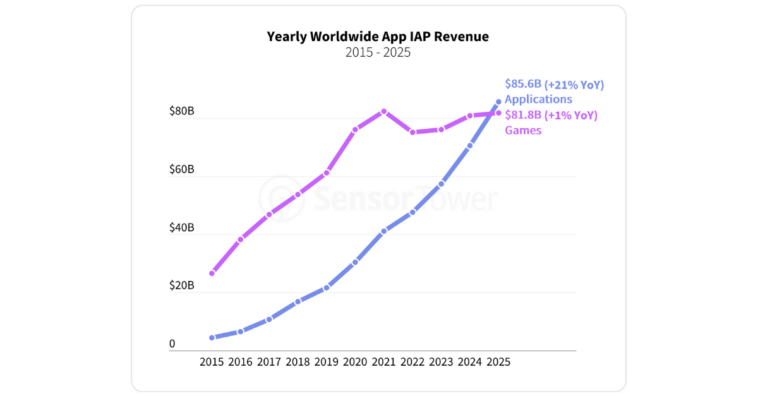
Global mobile in-app purchase revenue reached $167 billion in 2025, reflecting a market that continues to expand financially even as traditional growth levers such as downloads lose momentum. According to Sensor Tower’s State of Mobile 2026 findings, consumer spending grew 10.6% year over year, while total app downloads rose just 0.8%, highlighting a decisive pivot from scale-driven growth toward monetization efficiency.
Total time spent across mobile apps climbed to 5.3 trillion hours, up 3.8% annually. On average, users spent 3.6 hours per day on mobile apps and engaged with 34 apps per month, reinforcing mobile’s central role in consumer attention despite slowing adoption in mature markets.
Monetization Outpaces Installs as Market Matures
The imbalance between spending and downloads signals a broader shift in developer strategy. Rather than prioritizing user acquisition volume, leading apps increasingly focus on lifetime value, retention, and diversified revenue streams. Attention—not installs—is now the primary driver of monetization growth.
For the first time, non-gaming apps surpassed games in total mobile revenue, fueled by generative AI tools, social platforms, video streaming services, and productivity apps. Non-game in-app purchase revenue rose 21% year over year, while games grew more modestly at 1.3%, reflecting diverging maturity curves across categories.
Generative AI Reshapes Engagement Patterns
Generative AI emerged as one of the fastest-growing segments in 2025. Downloads of AI-powered apps doubled to 3.8 billion, while in-app purchase revenue nearly tripled to over $5 billion. User behavior also shifted sharply: time spent in AI apps surged to 48 billion hours, nearly four times higher than in 2024.
Notably, session growth outpaced download growth, suggesting that AI apps are moving beyond experimentation and becoming embedded in daily routines. This engagement pattern mirrors the broader mobile market’s transition toward deeper usage among existing users rather than rapid expansion of new audiences.
Mobile Gaming Grows Slowly as Downloads Decline
Mobile games posted a third consecutive year of revenue growth in 2025, with in-app purchase revenue approaching $82 billion, up roughly 1% year over year. However, this growth occurred despite falling download volumes, underscoring a structural shift toward monetizing established player bases.
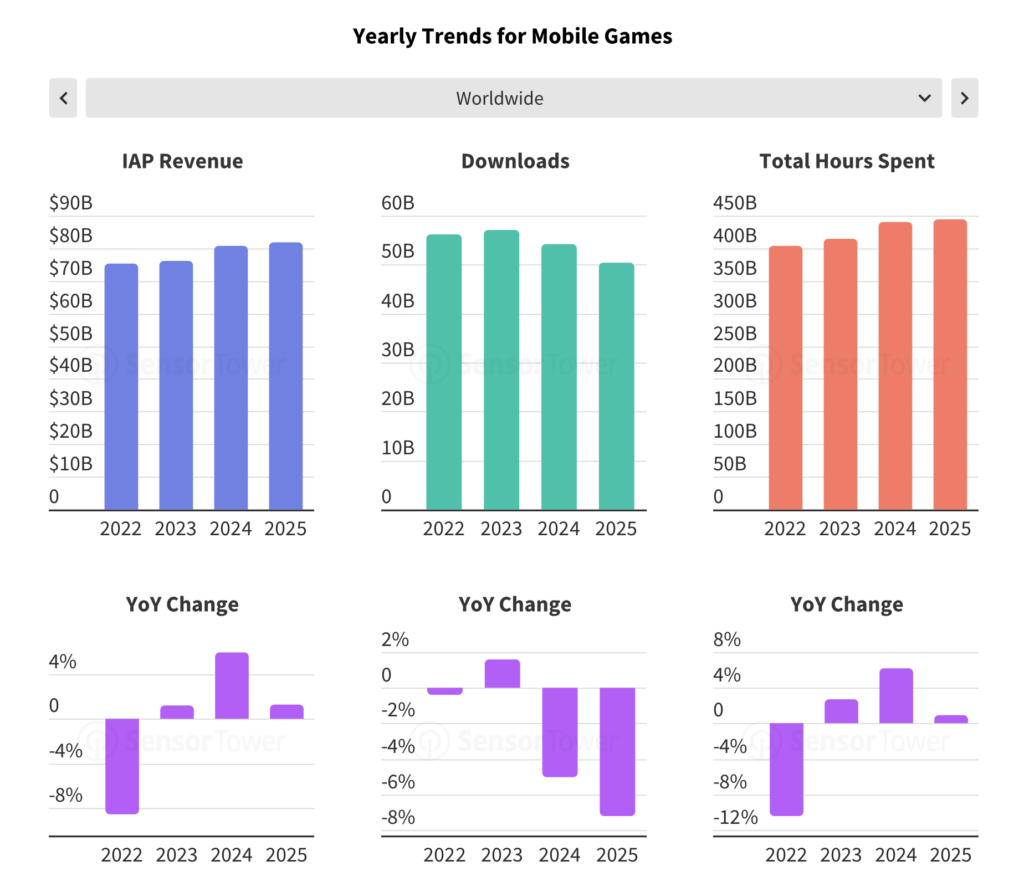
Regional performance varied. Revenue growth skewed toward Europe, while the US market remained largely flat. Exchange rate fluctuations may have influenced comparisons, particularly in parts of East Asia. Engagement trends also diverged: time spent rebounded in the US and Japan after declines in 2024, while mainland China saw continued softening. Within Europe, the UK strengthened, France remained stable, and Germany weakened slightly.
With fewer installs entering the funnel, game publishers increasingly rely on retention, reactivation, and disciplined payer management. User acquisition strategies are now judged by payback periods and conversion efficiency rather than sheer volume.
Advertising Spend Concentrates Into Fewer Platforms and Formats
The mobile advertising landscape also became more concentrated in 2025. Delivery shifted further toward high-attention formats, with video remaining dominant and playable and rewarded placements gaining share. As a result, format selection and creative execution now carry more weight than network breadth alone.
Platform consolidation accelerated toward Meta’s ecosystem, with Instagram and Facebook increasing share while TikTok and YouTube declined. Among ad networks, AppLovin and Mintegral grew by roughly 30% year over year, taking share from more established players such as AdMob, which posted only low single-digit growth. The trend points to a gradual move away from legacy networks in favor of performance-driven platforms.
Exposure also clustered into fewer genres. Puzzle games grew around 40% year over year, accounting for nearly 30% of global ad exposure, while leading sub-genres such as Match Pair, Sandbox, and Match Merge delivered more than three times the global average exposure. As volume concentrates, creative fatigue is accelerating, shortening the lifespan of effective ad concepts.
Ad Spend and Revenue Diverge by Genre
In the US, advertising budgets were heavily concentrated in Lifestyle and Puzzle games, which captured a disproportionately large share of ad spend relative to their in-app purchase revenue. Casino games showed the opposite dynamic, generating a higher share of revenue with comparatively lower ad investment. Action and Strategy titles were closer to equilibrium.
Japan displayed a similar imbalance in Lifestyle and Puzzle, but with Action and Strategy generating the majority of revenue while attracting less ad spend. These disparities suggest that categories with lower ad competition may offer more efficient user acquisition opportunities, while crowded genres face rising marginal costs.
Retention Pressure Builds in Casual Games
Retention data further highlights structural challenges within gaming. Among the top casual titles, day-seven retention declined steadily from 2022 through 2025, with similar softening across longer retention windows. Hybridcasual games, by contrast, improved relative performance and now outperform casual titles on several retention benchmarks.
The decline appears concentrated within casual games rather than across all models, pointing to category-specific fatigue and portfolio maturity. While standout exceptions remain—demonstrating that strong early retention is still achievable—the overall trend reinforces the industry’s pivot toward efficiency, durability, and long-term value creation.



Comments
Loading…