



 Maya Robertson
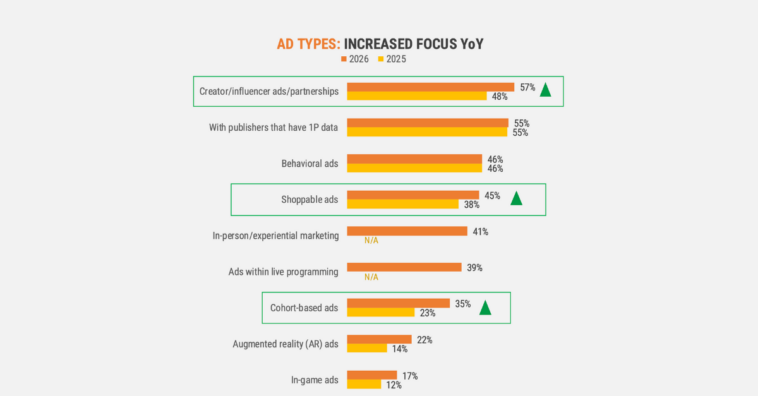
Influencer advertising is emerging as the top investment focus for marketers in 2026, according to the Interactive Advertising Bureau’s 2026 Outlook Study. The report shows that 57% of ad buyers plan to increase spending on creator partnerships this year, up from 48% in 2025, placing influencer marketing ahead of other ad formats in budget priorities.
The growing emphasis on creators comes as advertisers seek more human-led storytelling in an environment increasingly shaped by automation and artificial intelligence. While AI is becoming central to planning, activation, and measurement, buyers appear to be pairing these tools with influencer content to maintain authenticity and audience trust.
Performance data continues to reinforce this shift. Industry research cited in the IAB outlook indicates that creator-led content consistently outperforms brand-owned media on engagement and reach. A 2024 CreatorIQ analysis of Fortune 100 brands found influencer content generated significantly higher engagement and impressions, while the majority of organizations using influencer marketing reported stronger returns compared with traditional digital advertising.
The report also highlights how influencer marketing supports a wide range of objectives beyond awareness. Recent survey data referenced alongside the study shows marketers using creators to drive engagement, credibility, and revenue growth, aligning with a broader industry move away from pure acquisition and toward retention and lifetime value.
This strategic realignment is taking place against a backdrop of overall ad market expansion. IAB forecasts U.S. ad spend to grow 9.5% year over year in 2026, driven primarily by digital channels. Social media, connected TV, and commerce media are all expected to post double-digit growth, supported by AI-driven targeting and measurement. At the same time, five of the six top areas of increased focus for marketers this year are directly tied to AI, including the rise of agentic systems that automate media buying and campaign optimization.
Within this AI-heavy landscape, influencer marketing stands out as one of the few top priorities centered on people rather than technology. Buyers appear to be balancing autonomous decisioning tools with creator partnerships that deliver relatability and repeat exposure. Planning for longer-term influencer relationships and multiple touchpoints is becoming more common, reflecting evidence that consumers often need several creator interactions before converting.
The IAB study also notes that marketers’ challenges are evolving alongside these priorities. Adapting to changing consumer behavior is now the leading investment concern, while understanding and operationalizing generative AI has become a growing hurdle. As acquisition costs rise and first-party data strategies mature, repeat purchase and loyalty are gaining importance—areas where influencers are increasingly being used to support ongoing engagement rather than one-off campaigns.
Together, the findings suggest that in 2026, influencer marketing is no longer a supplemental tactic. Instead, it is becoming a core component of performance-driven strategies, operating alongside AI-powered media systems as brands look to combine efficiency, measurement, and human connection at scale.


Comments
Loading…