



 Sophie Blake
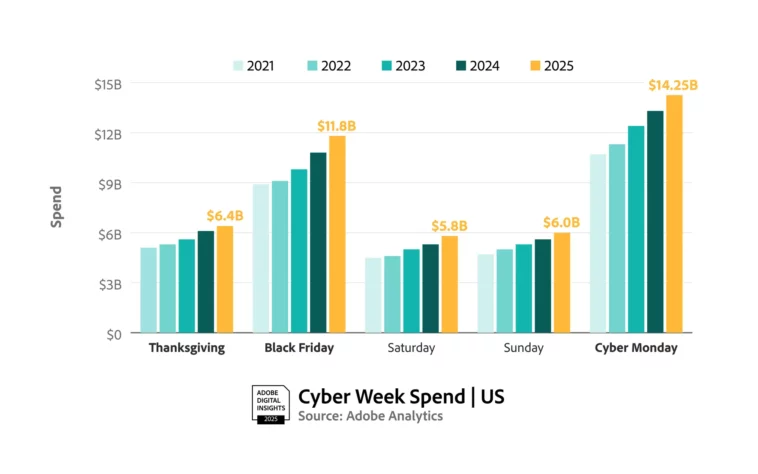
Cyber Monday 2025 generated a record $14.25 billion in U.S. online spending, according to new data released by Adobe. The total represents a 7.1% year-over-year increase and surpassed Adobe’s earlier projection of $14.2 billion. During the peak shopping window between 8 p.m. and 10 p.m., consumers spent roughly $16 million per minute, maintaining Cyber Monday’s position as the largest digital shopping day on record.
Discount activity remained a key driver. Electronics, toys, apparel, computers, televisions, furniture, appliances, and sporting goods all saw steep price cuts, with markdowns peaking at 31% for electronics. Adobe expects deals to continue through the first week of December, though at lower levels than those seen during Cyber Week.
Across the five-day period from Thanksgiving through Cyber Monday, online sales reached $44.2 billion, up 7.7% from last year. Black Friday delivered $11.8 billion—its second year of stronger growth than Cyber Monday—driven by earlier and more competitive discounting. Weekend spending also hit record levels with $11.8 billion in sales, while Thanksgiving brought in $6.4 billion.
Adobe forecasts total online spending for the 2025 holiday season (Nov. 1–Dec. 31) to reach $253.4 billion, a 5.3% annual increase.
Buy Now Pay Later usage reached an all-time high with $1.03 billion spent through the payment method on Cyber Monday, up 4.2% year-over-year. Nearly 80% of these transactions occurred on mobile devices. Shoppers reported using BNPL most frequently for electronics, apparel, toys, and furniture.
Across the holiday season to date, BNPL spending has totaled $10.1 billion, a 9% increase compared with last year.
Generative AI-powered tools saw a surge in activity as shoppers used AI to compare prices and research products. Traffic referred from AI chat services to retail sites increased 670% on Cyber Monday and is up 760% from November 1 through December 1. While the number of users remains relatively small, Adobe noted that AI is becoming a more common part of the online shopping process, particularly in categories such as video games, appliances, toys, electronics, and personal care.
Social media emerged as one of the most influential marketing channels this season. On Cyber Monday, it accounted for 3.6% of total online revenue, a 56.5% jump from last year. Influencer-driven “affiliates and partners” contributed 21.8% of revenue. Paid search and email remained important traffic drivers, but social platforms played a growing role in product discovery.
Mobile cemented its lead as the primary shopping channel, accounting for 57.5% of Cyber Monday sales, or $8.2 billion. Five years ago, mobile made up just 41.4% of Cyber Monday spending. On Thanksgiving Day, mobile share surpassed 60% for the first time.
Three categories—electronics, apparel, and furniture—made up 57% of Cyber Monday spending, led by $3.7 billion in electronics, up 12.8% from last year. Cosmetics, sporting goods, and home products also saw solid gains.
Across product trends, demand for specific consumer electronics surged. Bluetooth audio products, gaming consoles, refrigerators, home security systems, smart home devices, wearables, and vacuum cleaners saw increases ranging from 850% to over 1,800% compared with typical October sales levels. Popular toys included craft kits, STEM sets, Play-Doh, board games, KPOP action figures, Nerf products, and Paw Patrol items.
Games such as Call of Duty: Black Ops 7, Battlefield 6, Donkey Kong Bananza, Pokémon Legends, The Legend of Zelda franchise, and MLB The Show 25 ranked among the top sellers. Other high-demand items included cameras, luggage, athleisure, heated blankets, and home appliances.
From November 1 through December 1, consumers spent $137.4 billion online, up 7.2% from 2024. Mobile accounted for more than half of all purchases. Strong discounting has also pushed shoppers toward higher-priced items, with the share of expensive goods sold increasing 19% across all categories and rising more sharply in electronics, sporting goods, appliances, personal care products, and home improvement.


Comments
Loading…