



 Maya Robertson
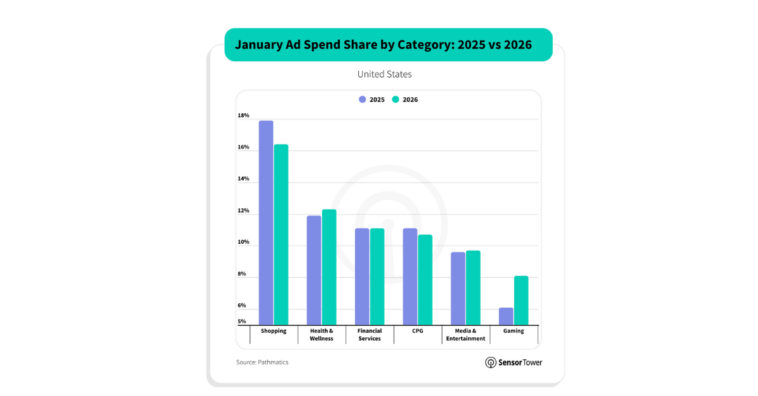
Global advertising outlays in January 2026 reached roughly $12 billion, matching the level recorded in January 2025, according to Sensor Tower’s latest analysis. While the headline figure suggests stability, category-level shifts within that spend indicate a recalibration of priorities at the start of the year, particularly across mobile-driven verticals.
The top six advertising categories accounted for approximately 69% of total January spend in both years. However, their internal ranking and relative share shifted, offering insight into where brands are concentrating budgets in early 2026.
January has historically over-indexed on sectors tied to New Year behavior, including wellness and personal finance. That pattern continued this year. Health and Wellness, which typically ranks as the third-largest category for most of the year, moved into second place in January 2026. The category captured about 12% of total ad spend in January, compared with its usual 10.5% share during the rest of the year. The seasonal bump reflects the commercial impact of resolution-driven consumer demand across fitness, nutrition, and mental health apps.
Per the report, shopping remained the largest category overall, but its share declined from December’s peak. In December 2025, 21% of ad dollars were allocated to Shopping amid holiday demand. By January 2026, that share had fallen to 17%, illustrating the predictable post-holiday pullback in retail advertising.
More structural changes are visible in the middle of the ranking. Financial Services continued its upward trajectory, claiming third place in January 2026 after ranking fourth in 2025 and fifth in 2024. Roughly one in every ten ad dollars in January was directed toward financial brands. The category overtook Consumer Packaged Goods (CPG), which slipped to fourth place. The shift signals sustained advertiser focus on financial products and services, with brands such as TurboTax, Progressive, and Capital One among the leading spenders.
Gaming posted the most notable year-over-year acceleration, the analysis says. January 2026 ad spend in the category rose 42% compared with the same month last year, pushing Gaming into the top six and displacing Food and Dining. In contrast, Food and Dining and CPG—both more exposed to discretionary consumer spending—lost ground in the rankings.
The increase in gaming ad budgets was accompanied by measurable changes in app performance. Gaming downloads grew modestly, rising 2% year-over-year to add approximately 21 million installs. Revenue, however, increased 5%, adding around $185 million. Revenue per download (RPD) climbed 8%, from $2.92 in January 2025 to $3.14 in January 2026. The divergence suggests a maturing acquisition environment, with publishers extracting more value from existing and newly acquired users rather than relying solely on install growth.
A similar monetization dynamic appeared in Health and Fitness apps. Although acquisition growth remained moderate, RPD increased 6% year-over-year to reach $3.39 in January 2026, outpacing download growth. The data indicates that developers across categories are leaning more heavily on pricing optimization, in-app purchases, and subscription models as new user growth stabilizes.
Taken together, January’s figures reflect a steady overall ad market with selective reallocation beneath the surface. Advertisers maintained aggregate spending levels but adjusted exposure toward Financial Services and Gaming while reducing emphasis on certain consumer-facing categories. In a month that often signals strategic direction for the year, the early data points to sustained investment in monetization-driven mobile verticals and continued pressure on categories tied closely to discretionary retail cycles.



Comments
Loading…