



 Sophie Blake
Publicis Groupe closed 2025 with organic growth above its own guidance, but the stronger-than-expected performance failed to reassure investors concerned about the pace and payoff of the holding company’s artificial intelligence strategy.
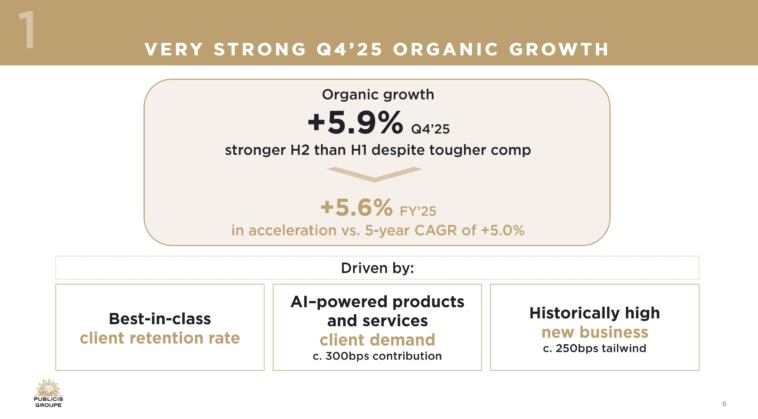
The French advertising group reported net organic revenue growth of 5.9% in the fourth quarter and 5.6% for the full year, exceeding its earlier forecast range of 5% to 5.5%. Looking ahead, Publicis expects organic growth of 4% to 5% in 2026, signaling confidence in continued momentum despite a more competitive and consolidated agency landscape.
Markets reacted cautiously. Publicis shares fell sharply following the results, dropping around 7% in midday trading and more than 3% at the market open, reflecting investor unease over rising AI-related spending and uncertainty about how quickly those investments will translate into durable financial returns.
Publicis has positioned artificial intelligence as the core driver of its future growth, favoring technology-led differentiation over scale at a time when rivals are getting bigger through consolidation. The group has doubled down on its CoreAI platform, embedding AI across media planning, targeting, and campaign execution. According to the company, AI now underpins roughly 73% of its operations and 80% of its media revenues.
Management argues this approach insulates the business from margin pressure and supports long-term expansion. Publicis leadership has repeatedly framed AI not as a cost burden, but as a structural advantage intended to improve efficiency and outcomes across client work.
That narrative, however, has yet to fully convince the market. Agency AI tools remain in an early phase, and questions persist over whether competitive advantage will come from proprietary platforms, data access, or execution at scale—or whether AI capabilities will quickly commoditize across the sector.
Skepticism is not limited to Publicis. Across the agency industry, AI adoption is accelerating faster than measurement frameworks. While many agencies report widespread or full deployment of generative AI tools, a significant share still lacks formal ROI measurement. Where performance is tracked, it is often limited to efficiency metrics such as time savings rather than revenue impact, effectiveness, or client outcomes.
Operational challenges also remain. Skills gaps, training requirements, and technology integration issues continue to slow deeper adoption, even as agencies race to deploy AI-driven solutions in response to client demand and competitive pressure.
This disconnect between investment and proof has become a focal point for investors, particularly as holding companies commit significant capital to AI infrastructure while facing pricing pressure, new entrants, and evolving client expectations.
For advertisers, the shift suggests agency relationships are increasingly defined by demonstrated performance rather than network size. As AI becomes more deeply embedded in planning and activation, marketers are likely to push for clearer evidence that these tools improve outcomes, not just workflows.
For Publicis, restoring investor confidence will hinge on translating its AI-heavy operating model into visible, measurable gains in revenue growth, margins, and client retention. The coming quarters will test whether the group can move from AI adoption at scale to AI-driven results at scale—at a time when competition among global holding companies is intensifying and patience in the market appears limited.


Comments
Loading…