



 Jordan Bevan
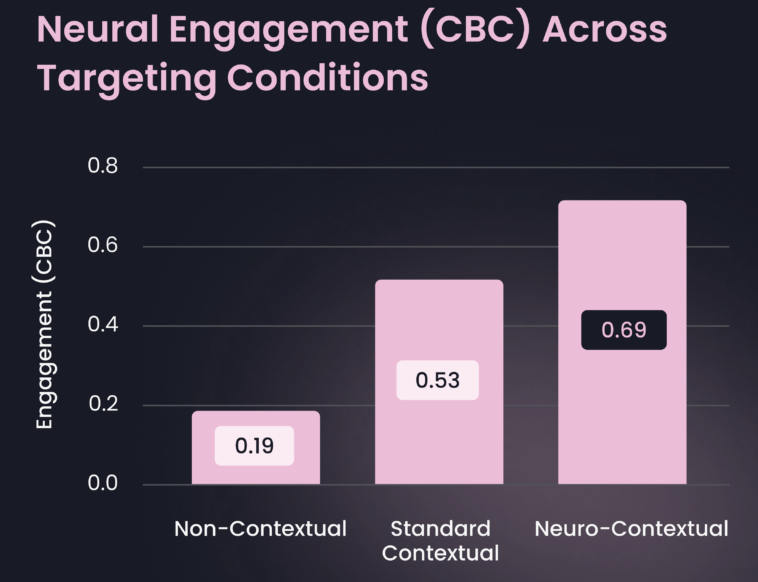
A new neuroscience study suggests that digital ads aligned with the emotional tone of the content surrounding them significantly outperform standard contextual placements. The research, conducted by Seedtag in partnership with Columbia University neuroscientist Professor Moran Cerf, examined how “neuro-contextual” ad environments influence attention, emotional response, and memory formation.
According to the findings, ads that match the emotional context of the page or content generate 3.5 times higher neural engagement than non-contextual ads and more than 30% stronger engagement than traditional IAB-defined contextual placements. The study also reports a 26% rise in positive, action-driving emotional responses, a factor tied directly to increased receptivity and lower cognitive friction.
Neuro-contextual advertising goes beyond conventional keyword or category-based targeting. It uses AI models informed by neuroscience to analyze signals such as emotional tone, interest level, and inferred intent. This approach seeks to identify the moments when a consumer is naturally more open to receiving information—what Cerf refers to as “brain alignment.”
Cerf explains that when the emotional state produced by content matches the emotional state invoked by an ad, the brain requires less effort to process it, which strengthens recall and engagement. This decreases what researchers call “cognitive load,” creating a more fluid experience that improves how the message is encoded.
Seedtag is one of several companies building AI-driven contextual systems aimed at deeper emotional understanding, alongside firms like GumGum, Cognitiv, Anoki, and Peer39. The broader trend reflects a shift away from third-party data reliance and toward real-time content and sentiment analysis.
The study found that neuro-contextually aligned ads were also linked to increases in left-side alpha brain activity, a marker associated with approach-oriented emotions—the kind that drive users to click, explore, or buy. By contrast, standard contextual ads, while effective at relevance matching, do not consistently account for emotional tone.
The findings indicate that planning strategies built on emotional and cognitive signals may offer a measurable lift in attention and memory, particularly on mobile where attention spans are shorter. For publishers, it suggests that pairing ad creative with the right content environment could have a direct impact on performance outcomes.


Comments
Loading…