



 Maya Robertson
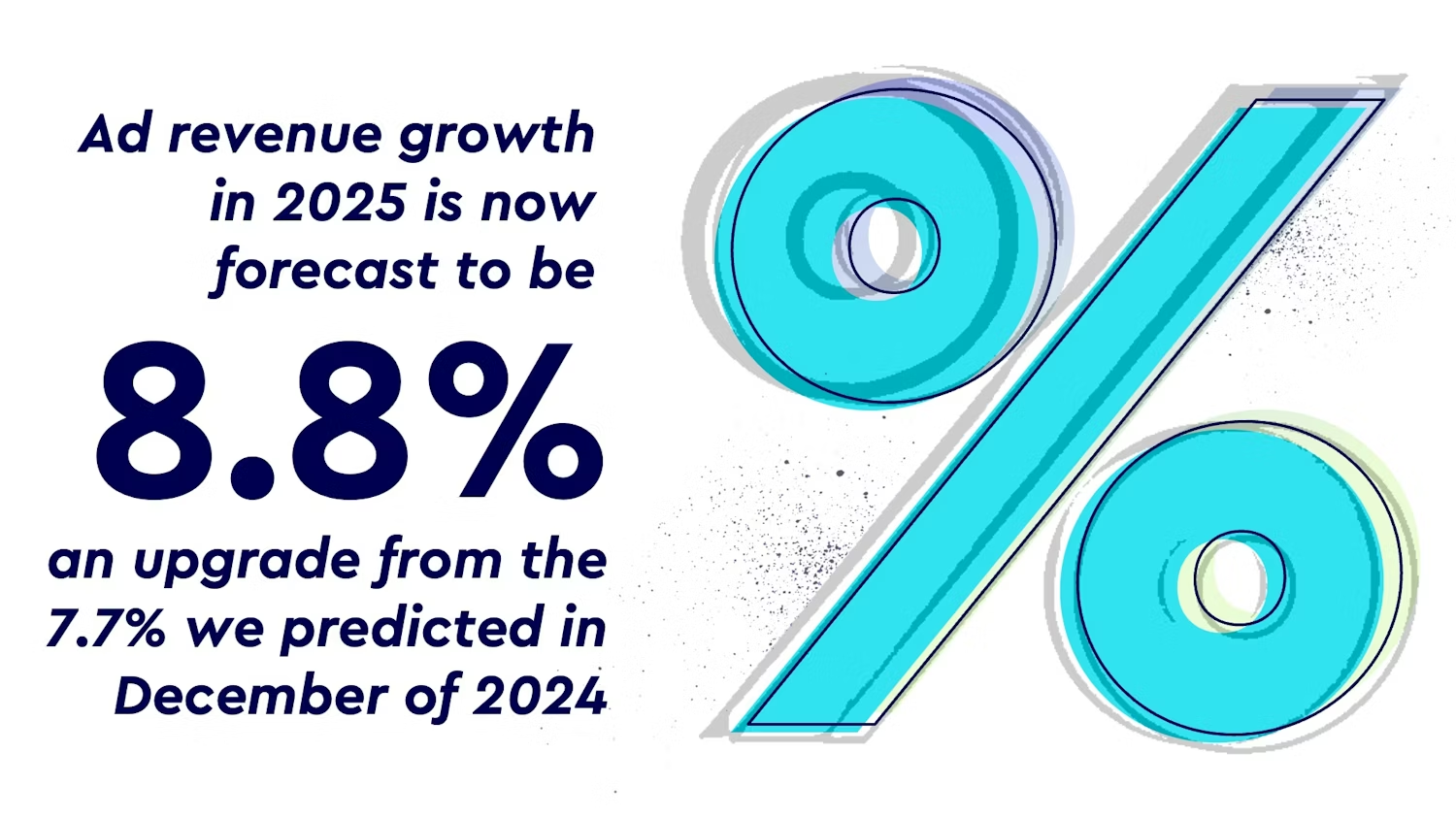
WPP has raised its global advertising growth outlook for 2025, citing stronger-than-expected tariff outcomes and a surge of AI-driven activity across the ad market. The company’s updated forecast now projects 8.8% growth for the year—up from its mid-year estimate of 6%—and a 2026 expansion of 7.1% (excluding U.S. political spending).
The revised expectations come as the industry adjusts to rapid structural changes: the ascent of commerce media, the redefinition of search, and the spread of AI across content production, planning, and measurement.
WPP has reorganized its reporting around four core segments: content, commerce, intelligence, and location. “Intelligence”—which now replaces traditional search—has quickly become the second-largest category, accounting for 21.4% of global spend in 2025.
The company plans to broaden what qualifies as intelligence in early 2026, adding AI-driven search experiences to the category. Executives said AI-first platforms are not yet materially impacting ad spend—pointing to “insignificant” revenue from Perplexity and the absence of ads in ChatGPT to date—but they expect that to change once larger players fully commercialize generative AI search.
WPP forecasts that intelligence spending will grow 10.3% next year before slowing into the high- to mid-single-digit range through 2030 as user behavior shifts from query-based search to systems that proactively deliver recommendations.
One of the most significant structural changes is the rise of commerce media. WPP estimates that advertisers will spend 15.6% of global budgets on retail, travel, and financial services media this year—surpassing combined linear and CTV spend at 14.6%.
Retail media networks are driving most of that growth. Amazon’s ad revenue, for example, reached nearly $18 billion in the third quarter alone, while retailers such as Carrefour and Target continue to expand their media operations. WPP expects the commerce segment to grow another 11.3% in 2026.
Buyers across the industry say the appeal lies in attribution: commerce media links ad exposure directly to purchase outcomes. That has made the channel particularly compelling to CPG advertisers, who increasingly prioritize measurable returns amid tighter budgets and faster reporting cycles.
While intelligence/search remains one of the largest global channels—expected to reach $244.9 billion in 2026—WPP predicts the pace of growth will slow as more queries move toward social platforms, retail environments, and AI assistants.
The company expects nontraditional search channels to expand more quickly because they start from smaller bases and deliver clearer signals tied to transaction or user intent.
A broader shift toward “proactive discovery,” where platforms surface results without direct user input, is expected to push advertisers to adjust budgets across search, social, and commerce ecosystems.
Content-driven advertising—spanning TV, social, video, and gaming—remains the industry’s largest category at $663.5 billion, or 58% of global ad revenue. Gaming is the fastest-growing subsegment, rising 29.5% year over year, though its overall share remains small at 0.7% of global spend.
Digital out-of-home continues to expand, projected to account for nearly 44% of all OOH revenue by 2030, reaching parity with traditional formats.
Despite the upward revision, WPP expects slower growth beginning in 2026. The lingering effects of earlier tariff increases, along with expanding age-gating requirements and new social platform regulations, are expected to exert pressure on several categories.
Executives also noted that surging 2025 spend sets a challenging baseline: record-high comparable figures make it increasingly difficult for year-over-year growth to accelerate.
WPP plans to introduce a new evaluation model for “advertising intelligence” at CES in January. The framework will score companies on AI capabilities, data assets, distribution strength, commerce integration, and content portfolios. WPP stated that Alphabet currently leads in most metrics.


Comments
Loading…