



 Jordan Bevan
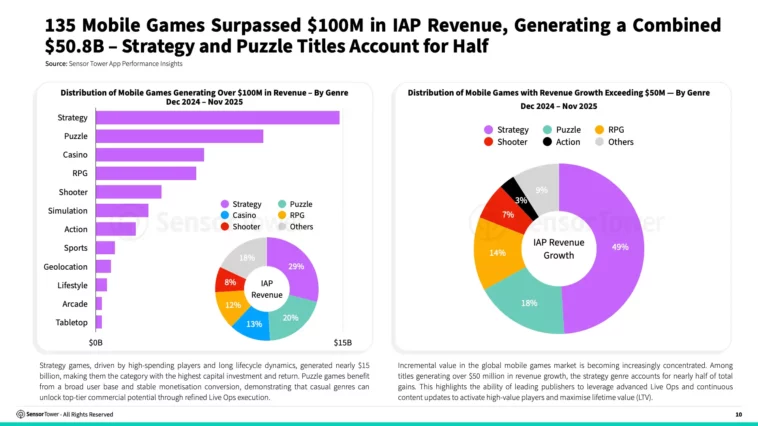
The global mobile games industry is entering a more mature phase, with revenue growth increasingly concentrated among a relatively small group of high-performing titles. In 2025, 135 mobile games each generated more than $100 million in in-app purchase (IAP) revenue, combining for a total of $50.8 billion, according to Sensor Tower.
The figures highlight a broader structural shift in the market. Overall mobile game IAP revenue is projected to reach $82 billion for the year, following a period of post-pandemic correction and stabilization in download volumes. Annual installs have plateaued at over 50 billion, indicating that expansion is no longer driven by user acquisition at scale but by deeper monetisation of existing players.
Within this environment, publishers are increasingly relying on “Live Ops” strategies to sustain engagement and revenue. These systems involve continuous updates, in-game events, and evolving reward structures designed to extend the lifecycle of titles and increase player spending over time.
Revenue concentration is particularly evident in specific genres. Strategy games accounted for nearly $15 billion in IAP revenue, driven by long-term player engagement and higher spending behavior. Puzzle games also remained a significant contributor, benefiting from broad user appeal combined with stable monetisation models.
Top-performing titles in the strategy category reinforced this trend. Last War: Survival and Whiteout Survival ranked among the highest-grossing games globally, with projected annual revenues of $2.4 billion and $2.2 billion, respectively. Their performance underscores the effectiveness of long lifecycle design and sustained player investment.
Central to these outcomes are increasingly complex Live Ops frameworks. Leading games deploy multi-layered event systems that run simultaneously, combining daily tasks, mid-term challenges, and large-scale seasonal events. This structure is designed to maintain constant player activity while creating recurring monetisation opportunities.
Recurring mechanics such as daily missions and progression milestones provide baseline engagement, while feature-driven systems like battle passes, limited-time mini-games, and reward-based events introduce periodic incentives to spend. At the highest level, large-scale events—often tied to seasonal or competitive themes—serve as peak revenue drivers by offering exclusive rewards and fostering competition.
Additional monetisation techniques, including sequential purchase offers and collection-based progression systems, are also being widely adopted. These mechanisms are structured to guide players through incremental spending paths, increasing conversion rates and overall lifetime value.
The findings indicate that success in the current mobile games market is increasingly tied to operational execution rather than initial launch performance. As user growth stabilizes, publishers are focusing on retaining players and maximizing revenue through continuous content delivery and structured engagement systems.



Comments
Loading…