



 Sophie Blake
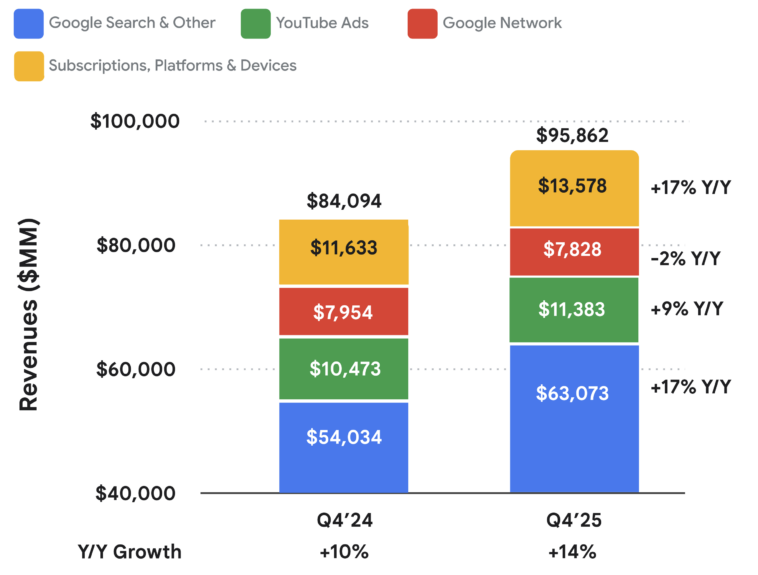
Alphabet’s latest earnings underline a structural shift in YouTube’s business, with advertising and subscriptions increasingly operating as parallel growth engines rather than sequential ones. In the 2025 financial year, YouTube generated $60 billion in total revenue, marking a 17% year-over-year increase, as paid subscriptions scaled alongside steady advertising expansion.
The results reflect a platform that is moving beyond its historic dependence on brand and performance advertising, while recalibrating inventory, formats, and pricing across long-form, short-form, and connected TV environments.
In the fourth quarter, YouTube reported ad revenue of $11.38 billion, up 9% year over year. While growth came in below analyst expectations, the company emphasized changes in how and where advertising dollars are being generated across the platform.
Short-form video continues to play a growing role in this mix. YouTube Shorts reached 200 billion average daily views during the quarter, holding steady year over year. While Shorts has historically lagged long-form video in monetization efficiency, Alphabet noted that in several markets, short-form ads now generate higher revenue per hour watched than traditional in-stream ads. This suggests that pricing models, ad load optimization, and user behavior are beginning to converge in favor of Shorts as a scalable ad format.
At the same time, connected TV (CTV) consumption remains a major driver of advertiser interest. YouTube continues to benefit from shifting viewing habits, particularly in mature markets where living-room viewing has become a primary screen for long-form content, sports, and podcasts.
Alongside advertising, subscriptions are becoming a more central pillar of YouTube’s revenue structure. Alphabet disclosed that it now has 325 million paying users across Google One and YouTube Premium, up from 300 million in the previous quarter. While the company does not break out YouTube Premium figures specifically, it confirmed continued traction for its $8-per-month ad-free tier, as well as bundled offerings tied to broader Google services.
YouTube Premium and related offerings reduce the platform’s exposure to cyclical ad spending while increasing average revenue per user among highly engaged audiences. This dual-revenue approach mirrors strategies seen across other major media platforms, where subscriptions are increasingly used to stabilize cash flow rather than replace advertising entirely.
Alphabet CEO Sundar Pichai signaled further expansion in this direction, particularly around YouTube TV. The company plans to introduce more than 10 genre-specific YouTube TV packages, aimed at increasing flexibility and retention in a competitive streaming market. While YouTube TV operates under different economics than the core platform, its growth supports YouTube’s broader positioning as a full-spectrum video ecosystem.
Beyond traditional video, podcasts are emerging as a meaningful engagement and monetization channel. Alphabet reported that viewers watched 700 million hours of podcasts on YouTube via TVs in October alone, highlighting how audio-first formats are being consumed visually and in shared environments.
For advertisers, this trend creates new inventory aligned with long-form attention and brand-safe environments, particularly on connected TV. Podcast advertising on YouTube increasingly overlaps with video CPM dynamics, rather than traditional audio pricing, expanding revenue potential per session.
YouTube’s monetization trajectory is also increasingly shaped by AI-driven discovery and creation tools. Alphabet stated that more than 1 million YouTube channels are now using its AI-powered creation features, while 20 million users engaged with Gemini-powered content discovery tools in December.
While these tools are not directly monetized, they influence watch time distribution, content surfacing, and creator productivity—factors that ultimately affect ad inventory availability and subscription conversion. Improved discovery can increase session depth, while creation tools lower barriers for new and mid-sized creators, broadening the supply side of the platform.
From an advertising perspective, AI-assisted discovery also supports more predictable content adjacency and targeting opportunities, particularly as YouTube balances personalization with regulatory and brand-safety constraints.
Taken together, YouTube’s results point to a platform optimizing for durable monetization rather than maximum short-term ad yield. Growth is increasingly spread across formats, screens, and revenue streams, reducing reliance on any single driver.
For marketers, this means YouTube is becoming less of a single-channel video buy and more of a multi-surface media environment—combining Shorts, long-form video, live content, podcasts, and CTV inventory under one buying umbrella. Subscription growth further complicates measurement, as a growing share of high-value users are partially or fully ad-free.
While advertising remains YouTube’s largest revenue contributor, subscriptions are now large enough to meaningfully influence product strategy, pricing decisions, and format investment. The $60 billion annual revenue figure underscores YouTube’s scale, but the underlying story is one of rebalancing, not acceleration alone.



Comments
Loading…