



 Sophie Blake
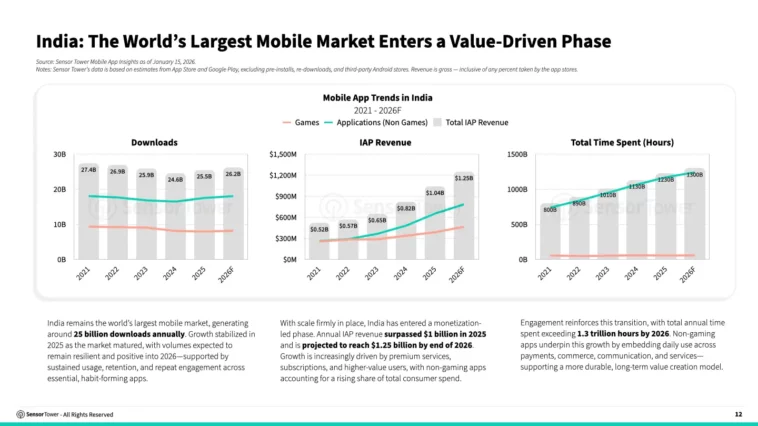
India’s mobile app economy is moving beyond its rapid expansion phase and into a period defined by monetization, engagement depth, and habit-driven usage, according to new 2026 market data. While the country continues to generate roughly 25 billion app downloads annually, growth has stabilized, reflecting a maturing ecosystem rather than a slowdown.
With scale firmly established, app publishers are now seeing value concentrate around retention and spending. According to Sensor Tower’s latest report, in-app purchase (IAP) revenue surpassed $1 billion in 2025 and is projected to reach $1.25 billion by the end of 2026, driven increasingly by subscriptions, premium services, and higher-value users. Non-gaming apps are accounting for a growing share of consumer spend, underscoring a broader shift away from download-led growth toward monetization anchored in daily use.
Utilities and Productivity apps remain the backbone of India’s app market, accounting for more than a third of total installs in 2025. Media & Entertainment and Social Media continue to deliver volume, while Financial Services, Shopping, and Jobs & Education sustain baseline demand. At the same time, Generative AI apps are leading absolute download growth, followed by Media & Entertainment, Food Delivery, and Social Discovery, signaling rising appetite for content, learning, and connection-oriented use cases.
Per the report, India’s shopping app landscape is showing clear signs of maturity. Downloads for broad, multi-category e-commerce platforms softened in 2025, while Apparel and Beauty retail apps continued to grow, pointing to stronger demand for specialized, high-intent shopping experiences.
Engagement trends reinforce this divide. Time spent on general shopping apps declined slightly, while Beauty retail apps continued to expand usage, particularly outside major metros. Platforms such as Nykaa and Purplle, alongside newer challengers, are benefiting from discovery-led experiences, repeat purchasing, and brand-focused positioning.
Regional markets are increasingly shaping India’s app growth trajectory. For several leading fashion and beauty apps, Tier-2 and Tier-3 cities now account for over one-third of active users, with cities like Kochi, Kozhikode, and Patna emerging as new demand centers. Localized assortments, value positioning, and region-specific marketing are becoming central to scale, reducing reliance on metro-driven growth.
Financial app downloads continued to grow in 2025, though at a slower pace, Sensor Tower says. Momentum has shifted away from digital wallets toward credit, lending, and mobile banking, as users move beyond transactions into savings, investments, and financial management.
Engagement growth has outpaced acquisition, signaling a transition toward multi-product financial behavior. Traditional banks are responding by redesigning apps with fintech-style interfaces, simplified navigation, and lifestyle features, narrowing the UX gap while still trailing fintechs on discovery and habit formation.
Entertainment apps are seeing rapid change, led by the rise of short-form drama platforms designed for serialized, mobile-first consumption. Global players and local platforms alike are investing in vertical video storytelling, frequent episode releases, and interactive mechanics. Hybrid monetization models—combining ads, micro-transactions, and episodic IAPs—are positioning short drama as one of the fastest-evolving entertainment formats in India.
Ride-hailing rankings have stabilized, with Rapido leading through bike taxis and autos, reflecting demand for affordable, everyday transport. Growth is increasingly shifting to driver-focused apps and regional mobility services, highlighting expansion driven by geographic depth and specialized use cases rather than headline user growth.


Comments
Loading…