



 Sophie Blake
Apple researchers have outlined a new experimental approach to AI-assisted interface design, introducing a system aimed at improving developer control during the prototyping process.
Detailed in a recent study, the tool—called SQUIRE (Slot Query Intermediate Representations)—is designed to address limitations commonly associated with AI-driven coding workflows, particularly when using natural language prompts to generate user interfaces.
Traditional prompt-based systems can introduce ambiguity and unpredictable outputs, often requiring repeated iterations to achieve the desired result. SQUIRE proposes an alternative interaction model that structures interface creation in a more controlled and incremental way.
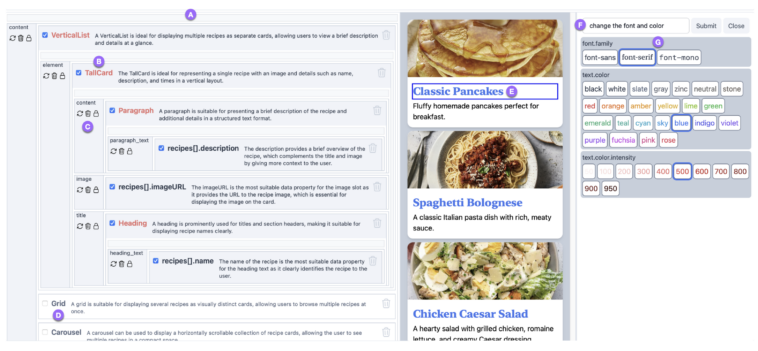
Instead of generating a complete interface from a single prompt, SQUIRE enables developers to build layouts step by step. The system represents the interface as a hierarchical structure of components, where each element can be defined, modified, or replaced independently. Developers begin with a high-level prompt and then refine specific sections by filling in placeholders—referred to as “slots”—with targeted instructions.
This approach allows the system to generate multiple design alternatives for a given component, which can be previewed and compared in real time. Changes are scoped to specific areas of the interface, ensuring that modifications do not unintentionally affect other parts of the layout. The system simultaneously updates both the visual preview and the underlying code.
Under the hood, SQUIRE operates through an intermediate representation layer known as SquireIR. This model structures the interface as a tree of components, including placeholders for undefined elements and multiple possible configurations. The system then translates this representation into front-end code using standard web technologies, including HTML, CSS, and JavaScript.
Another key feature is its handling of iterative changes. When developers adjust a specific UI element, the system limits updates strictly to that component. This reduces the trial-and-error cycles often associated with large language model outputs, where broader, unintended changes can occur.
The study involved a small group of frontend developers who used SQUIRE to build interface prototypes. Observations indicated that participants were able to iterate more frequently and experiment with different design paths, supported by the system’s ability to isolate and reverse changes without affecting the broader structure.
While SQUIRE remains a research project and is not publicly available, the concept reflects ongoing efforts to refine how AI integrates into development workflows. The system is powered by GPT-4o, though the study focuses primarily on interaction design rather than model architecture.
The research suggests a shift toward more structured and controllable AI-assisted development tools, particularly as interface design workflows evolve alongside advances in generative technologies.



Comments
Loading…